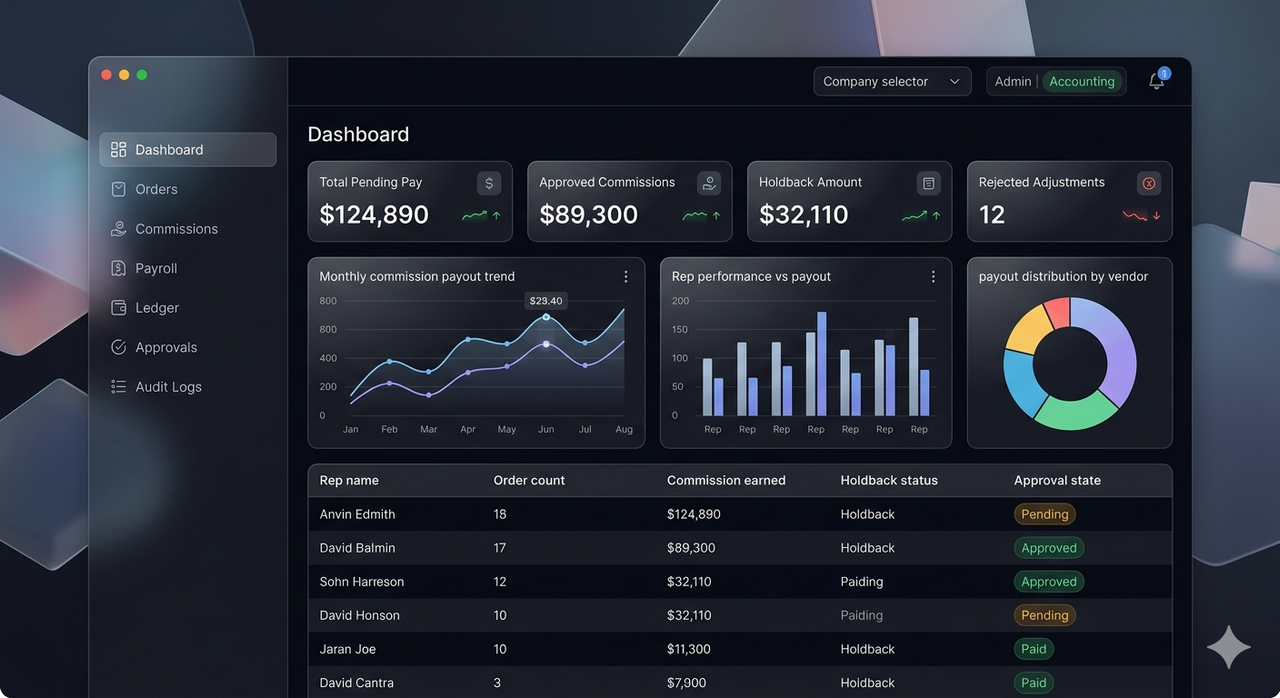
The operational system answers "what happened?" This layer answers "what is it worth, who approves it, and can finance trust it?"
If the sales platform captures what happened in the field, this finance engine decides what that activity is worth.
The operational system answers "what happened?" This layer answers "what is it worth, who approves it, and can finance trust it?"
Field sales data is only the first half of the business problem. A sales system can tell you which rep submitted which deal, but finance still has to answer the harder questions: which records are valid, which commissions are owed, which payouts are blocked, and which numbers can be trusted before payroll closes.
This case study focuses on the financial interpretation layer built above operational sales data. The goal was not to add another dashboard. The goal was to turn messy revenue activity into a reviewable, auditable, approval-driven finance workflow.
The field sales platform captures rep activity, mobile submissions, imports, and sales records.
This case study interprets that activity through commission rules, payroll approvals, ledgers, audit trails, and reporting.
Built for finance teams, operations managers, revenue leaders, and commission-heavy businesses that need trust beyond raw sales records.
Move payroll review away from spreadsheet memory and into a controlled financial system with clear status, ownership, and history.
The risky part of revenue operations is not only missing data. It is misinterpreted data. One duplicate record, wrong rep match, incorrect commission rule, or undocumented adjustment can turn into an incorrect payout.
Sales records existed, but finance still had to interpret them manually before payroll could be trusted.
Records moved through commission logic, payout status, holdback handling, review states, and approval workflows.
Commission calculations, holdbacks, and payout review were handled through manual files, creating version conflicts and slow month-end checks.
Sales records move through rule-based commission logic, pay multipliers, holdback handling, and payroll-ready summaries.
Financial changes could happen without enough context around who changed what, why it changed, and when it happened.
Important financial updates are tracked so admins and accounting users can review the history behind numbers instead of guessing.
Managers lacked a clear view of pending commissions, team performance, rep payouts, and exceptions needing attention.
Manager and accounting dashboards surface the records that need review, approval, correction, or export.
I moved commission handling out of fragile spreadsheet formulas and into application logic backed by PostgreSQL. The system accounts for commission amounts, holdbacks, payout status, rep associations, vendor/product context, and payroll review states so financial numbers are calculated the same way every time.
A submitted sale is not automatically a payable commission. The finance engine separates operational activity from financial readiness, so records can be reviewed, corrected, held, approved, and exported with clear status changes.
The finance layer treats money movement as structured records, not loose table cells. That made it possible to separate sales activity from payable amounts, review pending pay, track adjustments, and keep accounting outputs aligned with the platform's source of truth.
Manual finance operations break down when nobody knows why a number changed. I added audit-friendly patterns around sensitive financial operations so the business can inspect the history behind payroll changes, not just the final result.
Because the platform supports multiple companies, payroll data cannot leak across tenants. I used role-aware views and database-level security boundaries so admins, managers, sales reps, and accounting users only see the financial records they are allowed to see.
Managers and accounting users needed answers without asking a developer to run queries. I organized reporting around the questions they actually ask: which commissions are pending, which reps are ready for payout, which records need review, and where exceptions are blocking payroll.
Raw sales activity
  -> validation and matching
  -> commission rules
  -> holdbacks and adjustments
  -> payroll review states
  -> manager/accounting approval
  -> exportable financial reporting

Control layers:
  - company isolation
  - role-based access
  - audit logs
  - reporting views
  - exception handling
The finance engine sits above the operational sales database, but its job is different. It turns raw activity into reviewable financial records:
Commission, holdback, and payout logic moved from spreadsheet formulas into repeatable system rules
Records can move through review, correction, hold, approval, and export states with clearer accountability
Managers can inspect team-level commissions, pending payouts, rep performance, and exceptions
Accounting users can import or export operational data without making spreadsheets the source of truth
Multiple companies can operate inside a shared system while financial data stays separated
Financial records are structured for review, reconciliation, adjustment, and reporting
Sensitive changes have a clearer history so the team can trace why financial records changed
Duplicate and mismatched records can be reviewed and corrected with less risk to production data
Payroll and finance views are organized so accounting can review records before payout
Admins, accounting users, managers, and reps see different financial surfaces based on responsibility
Key financial views update from platform data instead of being rebuilt manually at payroll time
Payroll review no longer depends on fragile formulas, private files, and scattered manual notes
Finance can review pending payouts through system states instead of rebuilding context from scratch
Team performance, pending commissions, and rep-level financial context became visible in dashboards
Each role sees only the financial records it is authorized to review or act on
Payroll-ready summaries can be produced from platform data instead of manually assembled exports
Commission and payout logic became consistent across records, reducing room for formula mistakes
CSV import and export give the finance team flexibility while keeping the platform as the main record
Separate companies can run finance workflows without cross-company leakage or mixed reporting
"Appreciate you, keep doing good work." - Private project feedback
I help businesses turn messy finance workflows into production systems with approvals, audit trails, dashboards, and reliable data boundaries.